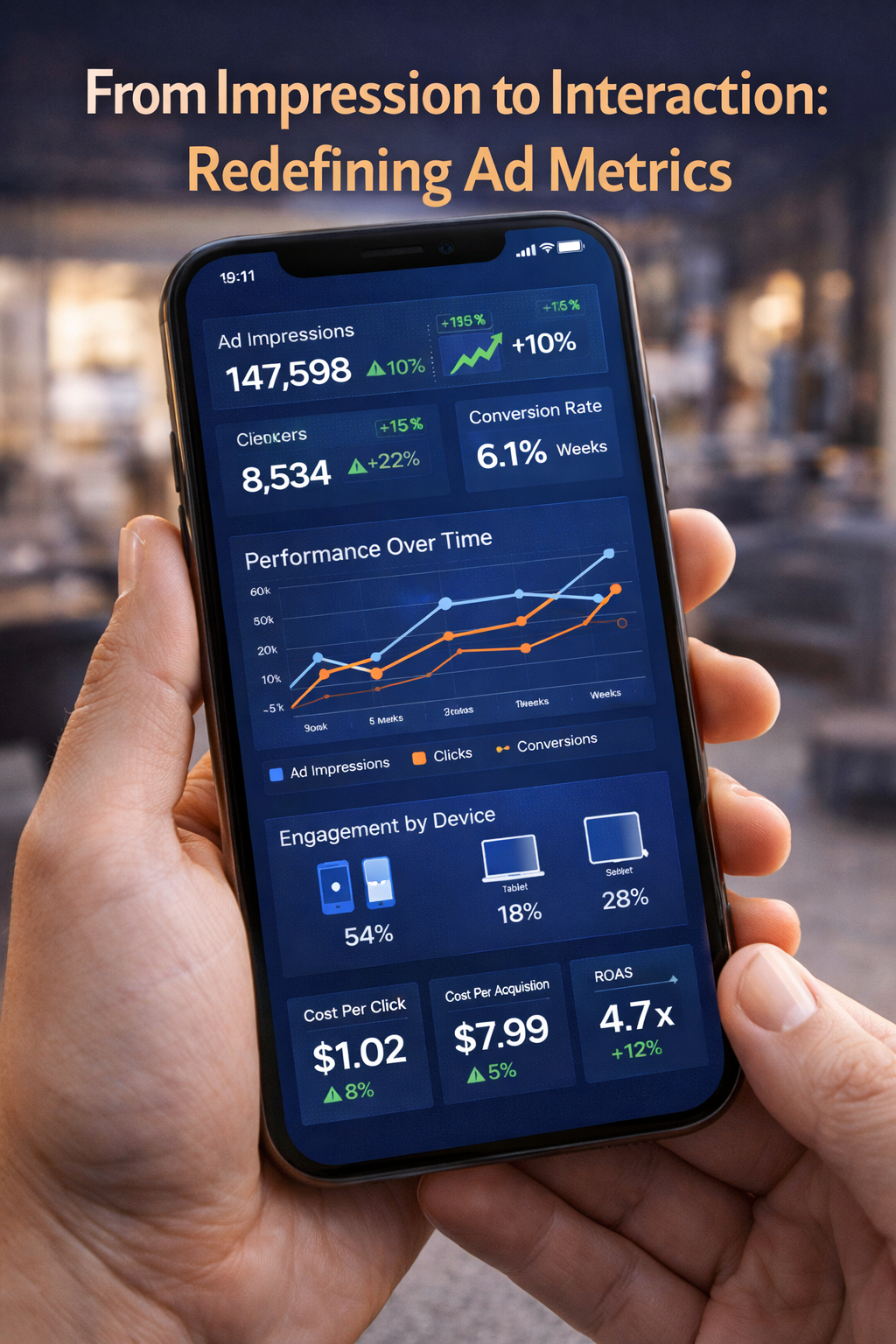
The impression has been the foundational unit of advertising for as long as advertising has existed. How many people saw your billboard? How many eyeballs were in front of the TV during your commercial? The impression is a count of exposures — and for most of advertising history, it was the best measurement tool available.
The digital era was supposed to fix this. Suddenly, marketers had clicks, engagement rates, bounce rates, time-on-page. But in replacing one imperfect proxy with a different set of imperfect proxies, it didn’t solve the fundamental measurement problem. It just created new ways to report activity without proving impact.
The Impression: What It Actually Measures
An impression measures opportunity for exposure. It tells you that a piece of content was rendered on a screen in the proximity of a human being. It does not tell you whether that human being looked at it, processed it, felt anything about it, or took any action as a result.
Programmatic advertising platforms now serve billions of impressions daily, a meaningful percentage of which are served to bots, below the fold, or in non-viewable contexts. Paying for impressions is paying for the possibility of attention.
The Click: A Better Proxy With the Same Problem
The click was supposed to solve the impression problem by measuring intent. This was mostly true in the early days. But click behavior evolved — people click accidentally, bots click, publishers discovered ways to generate fraudulent clicks.
The average click-through rate on display advertising has declined to approximately 0.1%. When 999 out of 1,000 people don’t click, the 1 who does is not a strong signal about campaign effectiveness.
What Interaction Actually Measures
When a customer scans a QR code and engages with an XR+AI experience, the data produced is fundamentally different:
- Chosen engagement — The customer made a deliberate decision to interact. There’s no accidental scan.
- Active time — Dwell time in an interactive experience reflects sustained, voluntary attention.
- Behavioral choices — What did the customer interact with? What did they share? These reveal preferences and intent that passive metrics can’t access.
- Return behavior — Did the customer come back? A return scan is one of the strongest intent signals in marketing.
The New Metrics Framework
Engagement Rate by Encounter
Of the customers who encountered the experience, what percentage chose to engage? This measures whether the experience was compelling enough to earn active participation.
Interaction Depth Score
Did customers engage with one feature or multiple? Interaction depth measures experience quality and content relevance.
Social Amplification Rate
What percentage of customers shared the experience? Each share is a first-party endorsement to a new audience.
Post-Engagement Conversion
Of customers who engaged, what percentage completed the downstream conversion action? This connects XR engagement to business outcomes.
The Accountability Shift
The shift from impression-based to interaction-based measurement is ultimately an accountability shift. Impressions give brands cover. Interaction data is harder to hide behind — either customers are engaging or they’re not, either engagement is converting or it’s not.
The metric that matters is not how many people were in the vicinity of your message. It’s how many people chose to engage with it, for how long, and what they did afterward.
Experience the difference first-party behavioral data makes at sugarxr.com. Attention is hard to get. Engagement is hard to forget. SugarXR delivers both.